

Puerto Rico occupies a strategic geographic position for the United States and the Caribbean, an advantage that has become increasingly significant in light of recent changes in the regional security landscape. The situation in Venezuela has directly influenced this dynamic, leading to a sustained increase in the U.S. naval presence in the Caribbean Sea.
Since mid-2025, the United States has significantly increased its maritime and air assets in the Southern Caribbean and around Puerto Rico as part of a broader operational strategy.
This deployment (including a significant number of warships, aircraft, and military personnel) has been reported as one of the largest in the region since the early 21st century and reflects Washington’s renewed focus on the stability of maritime routes and security in the region.
This new level of military presence in the region is not merely a strategic fact. It has concrete operational implications. Every deployed vessel, every extended mission, and every additional port rotation brings with it more complex logistics.
It is here that the capacity to supply fuel and lubricants ceases to be a secondary support function and becomes a critical element for sustaining the operation.
How does the increased naval presence impact fuel logistics?
The increased naval presence implies higher fuel consumption and less margin for disruptions. Vessels operating in the region conduct patrols in sensitive corridors, monitor maritime traffic, carry out rescue missions, and support strategic operations. All these functions require a constant supply of energy.
In this type of operation, the frequency of refueling can vary depending on the intensity of the missions. There are periods of sustained activity and others when consumption rises rapidly. If the supply chain lacks responsiveness, the operation begins to operate with reduced margins.
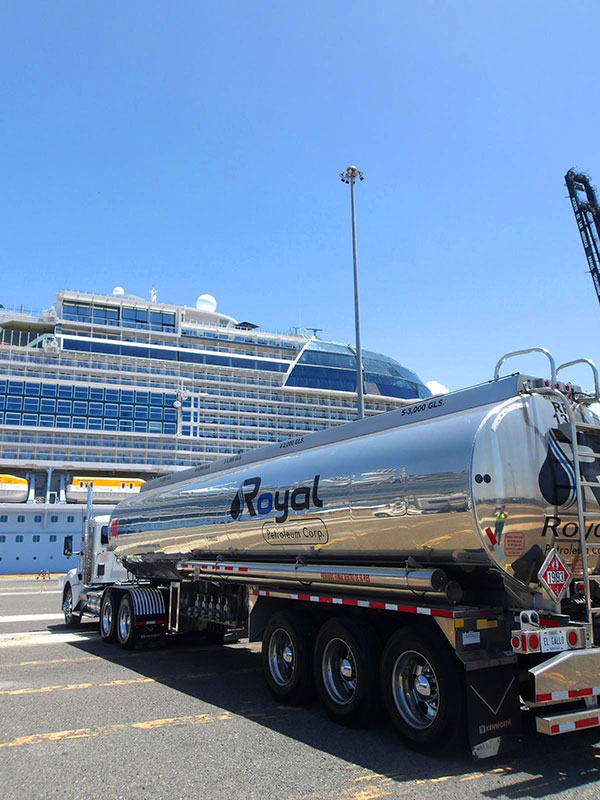
Fuel supply for the U.S. Navy and the U.S. Coast Guard is not managed like a conventional commercial delivery. It requires constant quality control, precise documentation, advance coordination, and complete traceability. The difference lies not only in the volume delivered but also in the precision with which each shipment is executed.
At American Petroleum, together with Royal Petroleum, our subsidiary specializing in marine services, we have the necessary protocols and processes to meet these exacting standards.
Fuel Supply for Naval Operations in Puerto Rico
In naval operations, the continuity of supply is not a minor operational detail. It is a structural requirement. A vessel that cannot refuel on time compromises its schedule, its response capability, and, in certain scenarios, the very execution of the mission.
Fuel quality is equally critical. In high-performance fleets, a deviation from specifications can affect performance, cause mechanical failures, or increase unnecessary risks. That is why fueling for the U.S. Navy and the U.S. Coast Guard must be carried out by a qualified supplier.
At American Petroleum, we are certified and authorized by the U.S. Coast Guard, which validates our storage, handling, and dispensing procedures in accordance with the standards applicable to these types of operations, and positions us as a reliable partner within the fuel supply chain.
Lubricants for Fleets and Auxiliary Systems
Fuel powers the vessel’s movement, but lubricants maintain its internal operations. In the marine environment, constant exposure to moisture and salt spray accelerates mechanical wear if products with appropriate technical specifications are not used.
At American Petroleum, we offer a portfolio of lubricants designed to meet the demands of high-performance marine engines, hydraulic systems under continuous pressure, and auxiliary equipment that supports operations.
We work with recognized brands such as Mobil, Petro-Canada, Phillips 66, and our own line, American Quality Lubricants (AQL), which allows us to offer solutions aligned with demanding technical specifications.
Logistics Execution and Operational Compliance
The availability and quality of fuel and lubricants are essential, but they are not enough on their own. Logistics execution is what ultimately sustains the operation.
From our base in Mercedita, Ponce, we coordinate operations and shipments at Puerto Rico’s major ports, with direct access to the product and control over every movement. When a vessel arrives in port, the bunkering must be ready to proceed, without waiting for last-minute confirmations or adjustments.
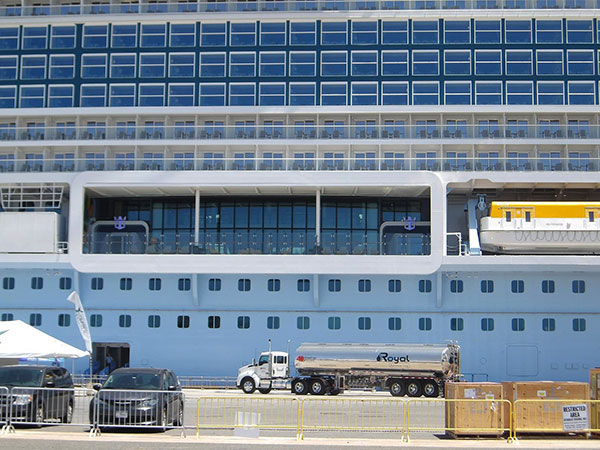
We operate our own fleet to the island’s main ports and conduct truck-to-vessel operations, in which fuel is supplied directly from our trucks to the vessel at the dock, following defined protocols. This approach shortens response times and reduces unnecessary intervention points.
Storage, transportation, and delivery are carried out based on structured procedures that prioritize consistency and risk reduction. Product control, corresponding documentation, and regulatory compliance are part of the operational workflow, not an additional step.
American Petroleum, a specialized supplier for security agencies
Providing services in environments related to maritime safety requires product availability, responsiveness, robust infrastructure, operational control, and sustained execution. And not all suppliers can meet that level of demand.
For more information about our fuel and lubricant supply services in Puerto Rico and the Caribbean, please visit our website or request information at info@americanpetroleumpr.com